Glossary
Real terms used across the NCFCA architecture — each definition sourced directly from the formal proof or a verification page, with a link to where the full context lives. Growing as real terms get defined; not a finished, closed list.
Originalterm coined or precisely defined by this architecture · Generalstandard term used with a specific meaning here
- Anomaly Window Original
-
A maximal interval during which the execution profile's anomaly indicator δ(t) equals 1 — i.e., the Calibration Execution Profile exceeds a domain-specific threshold θC. Starts at onset (t₀), ends the first moment δ(t) returns to 0 (t₁).
- Calibration Execution Profile (CEP) Original
-
One of the four NCFCA profiles. Captures execution state (C) — response latency, error rate, system-level reliability signals. Acts as the system's circuit breaker: when it exceeds threshold, it suspends writes to the Dynamic State Profile.
- Circuit Breaker Protocol Original
-
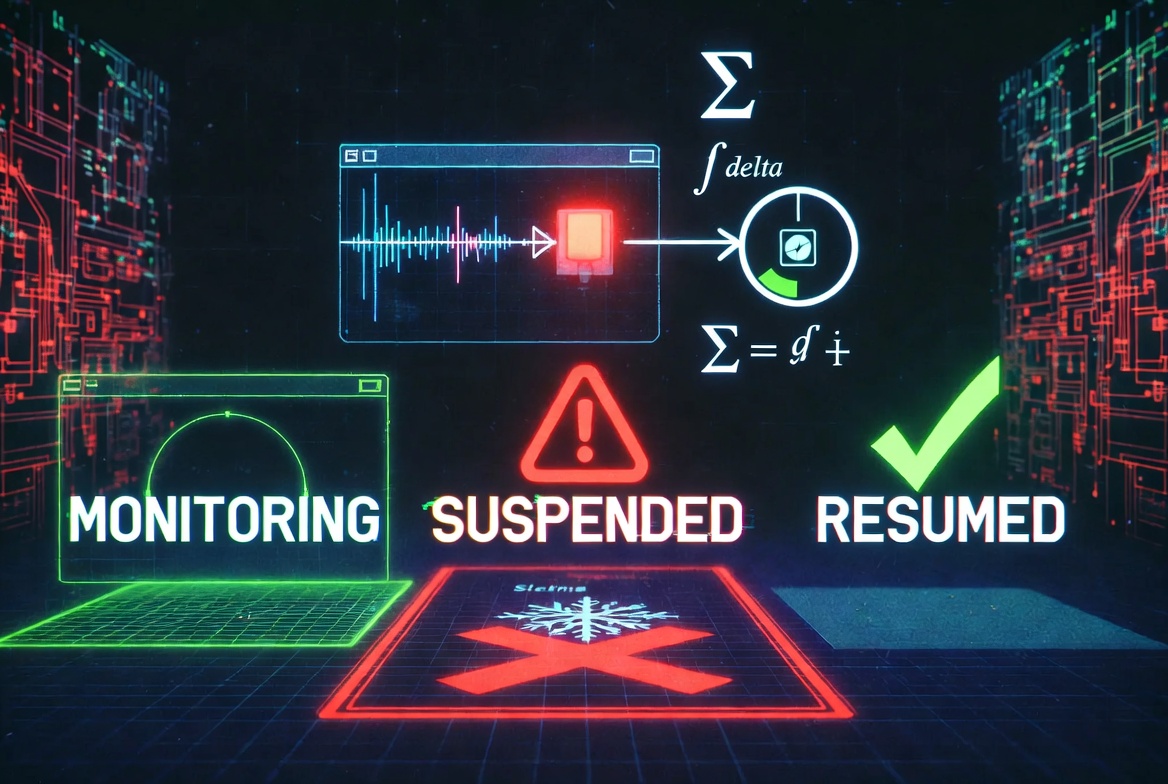
The write-suspension rule Φ(t) = 1 − δ(t): permits writes to the Dynamic State Profile when Φ(t)=1, suspends all writes when Φ(t)=0. Equivalently specified as a three-state finite state machine: MONITORING → SUSPENDED → RESUMED.
- Dynamic State Profile (DSP) Original
-
One of the four NCFCA profiles. Captures genuine internal state (D) — a directed acyclic graph of concept or skill nodes with mastery states. Write access is subject to circuit-breaker suspension; this is the profile the whole architecture exists to protect.
- Evidence Fraction Original
-
The real, computed fraction of currently-registered invariants a claim has actually been checked against — not a hand-typed confidence number. Computed directly from a Verification Registry's records; a claim's evidence fraction drops automatically when a new invariant is added, without anyone manually flagging it.
- Forward-Walk (Validation) General
-
Testing a strategy or model on data chronologically after the period it was built or tuned on — as opposed to backtesting twice on the same historical window. A strategy discovered in-sample and then run unmodified on genuinely later, unseen data.
- Governance Layer Original
-
Applies structural rules across multiple estimator outputs before producing one governed decision: confidence gating, disagreement detection between estimators, and a circuit breaker on extreme-and-uncertain results. Distinct from TestingGovernance, which governs execution-kernel fault-injection testing — two real mechanisms for two different pipelines, not competing versions of one thing.
- Interface Response Profile (IRP) Original
-
One of the four NCFCA profiles. Captures interface state (I) — friction from how a question or interaction was presented, distinct from whether the underlying content was understood. Updated from State Context Profile signals only.
- Kernel Registry Original
-
The real, current registry of every kernel in the lab — 15 as of this writing, classified into 5 real families. Lets an orchestrator (or a person) check a kernel's real lifecycle requirements before running it, instead of finding out via a crash.
- Lower-Triangular Causal Pipeline Original
-
The causal graph over the four profiles, restricted to edges (S→D, S→I, D→C, I→C). Under the ordering S ≺ D ≺ I ≺ C, the adjacency matrix is strictly lower-triangular — meaning no edge ever points from a "later" profile back to an "earlier" one. This structure is what Theorem 1 proves prevents execution state from causally influencing internal state.
- Non-Collapsibility (Rule) Original
-

The four NCFCA profiles must be maintained as structurally independent data structures. No write path may exist in the data model permitting a value from the Calibration Execution or Interface Response profile to directly modify the Dynamic State Profile. The profiles may not be averaged, merged, or projected into a shared representation at any stage.
- Schema Floor Original
-

The confirmed, pre-anomaly value of the Dynamic State Profile that must be preserved — not degraded or overwritten — while the circuit breaker is suspended during an anomaly window. Theorem 2 proves the prerequisite-gated update rule combined with the circuit-breaker protocol preserves schema floor integrity during execution anomalies.
- Signal Smearing Original
-
What happens when four categorically distinct signal classes (S, D, I, C) are mixed into one composite measurement before separation is attempted. Once mixed, the information required to separate them is gone — not a statistical estimation problem solvable with a better algorithm, but a structural information problem (Proposition 1.3). The named problem NCFCA's architecture exists to prevent, not correct after the fact.
- State Context Profile (SCP) Original
-
One of the four NCFCA profiles. Captures environmental state (S) — conditions external to the learner or system that aren't a reflection of genuine understanding. Resolved prior to any inference over the Dynamic State Profile.
- Value Laundering Original
-
A real vulnerability found in Claim 1's isolation guarantee: a value's declared source label was checked, but its actual computational provenance wasn't traced — meaning a value could carry an honest-looking label while its underlying computation had actually mixed channels upstream. Found, diagnosed, fixed, and regression-checked.
What's next for this page
The real 91-term glossary already built for the education and fitness frameworks (gregorylacefield.com side) is a separate, upcoming batch — kept apart from this pass to avoid rushing the migration and introducing errors. This page will grow term by term as real definitions get established, not all at once.
Comments